

What Is an AI Workforce? How Digital Employees Can Help Run a Business
Artificial intelligence is quickly moving beyond simple chat conversations. A new model is emerging: businesses organizing specialized AI employees around real responsibilities, workflows, research and business outcomes.
For years, most businesses have experienced artificial intelligence in roughly the same way: open an AI application, type a question into a chat box and wait for a response.
That can be extremely useful, but it does not necessarily resemble the way a real organization operates.
Businesses have people with different responsibilities. They have departments, projects, deadlines, goals, records, meetings, approvals and processes.
That is where the idea of an AI workforce becomes interesting.
An AI workforce is a collection of specialized digital employees or intelligent systems organized around different roles and business responsibilities instead of relying on one general-purpose AI assistant for everything.
AI workforce vs. one general AI assistant
Imagine a business owner who needs help with marketing, research, accounting, cybersecurity, technology, customer experience and operations.
One approach is to bring every question to the same AI conversation.
Another approach is to organize artificial intelligence around specialized responsibilities.
General AI Conversation
AI Workforce
The shift is not simply from humans to AI. The more useful shift may be from isolated AI conversations to organized AI-assisted work.
What can digital AI employees actually do?
The exact capabilities depend on the software and business environment, but digital employees can be organized around responsibilities that already exist inside companies.
Executive Coordination
Help organize priorities, business plans, missions, summaries and decisions that require leadership attention.
Marketing
Assist with campaign ideas, positioning, audience research, content planning and marketing operations.
Research
Gather relevant information, organize sources, identify trends and prepare useful business briefings.
Operations
Help structure workflows, recurring work, processes, reports and operational planning.
Technology
Support technical planning, systems, integrations, infrastructure and technology research.
Finance & Records
Organize bookkeeping-related information, business records and accounting-oriented workflows.
Why business context matters
A marketing assistant that knows nothing about the company may produce technically correct marketing ideas that are completely wrong for the actual business.
The same applies to operations, research, technology and accounting.
A useful AI workforce should be able to work with relevant organizational information such as the company's products, customers, priorities, challenges and operating goals.
That context can make the difference between a generic AI answer and work that actually reflects the organization.
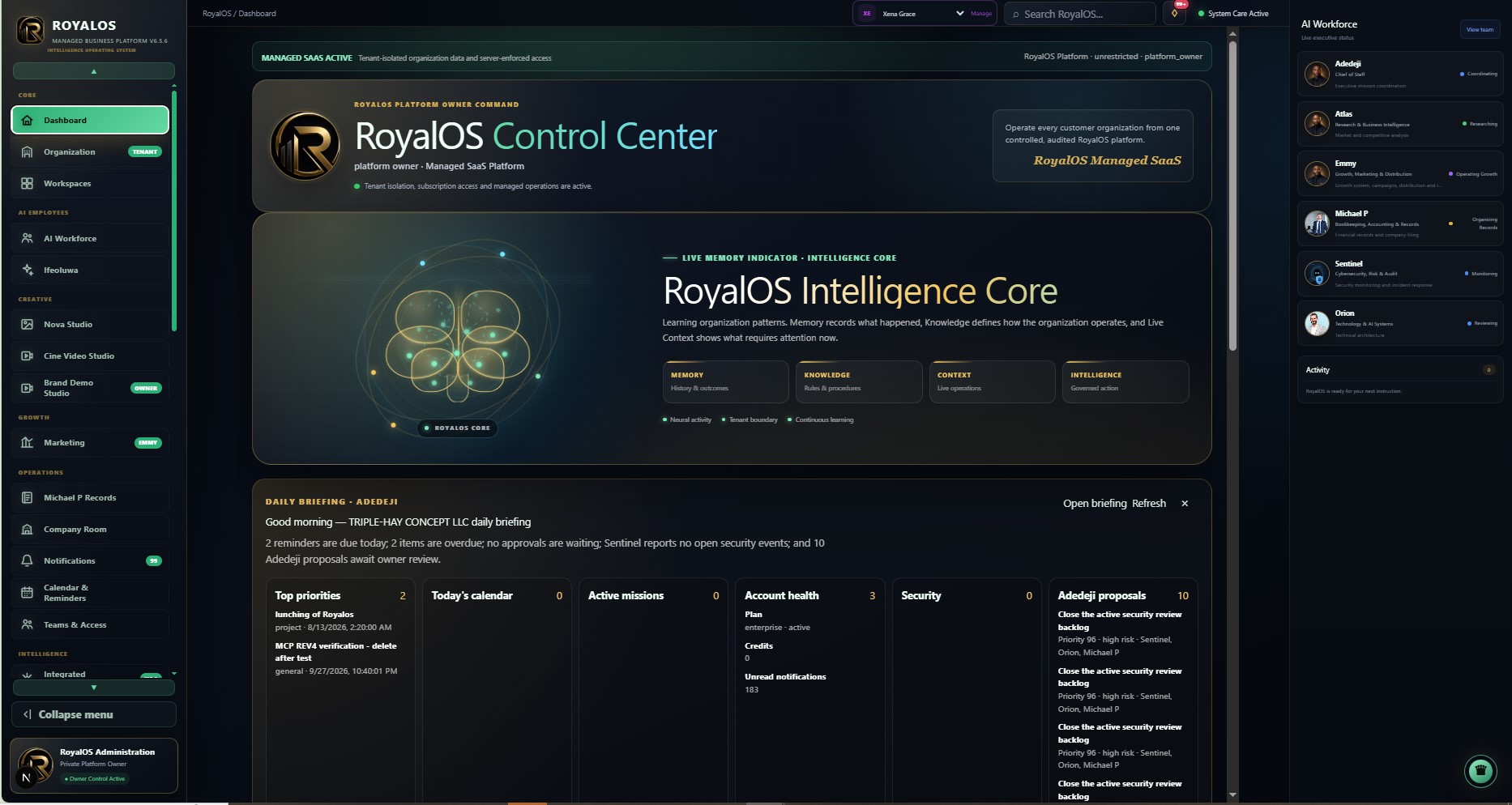
What does an AI workforce command center look like?
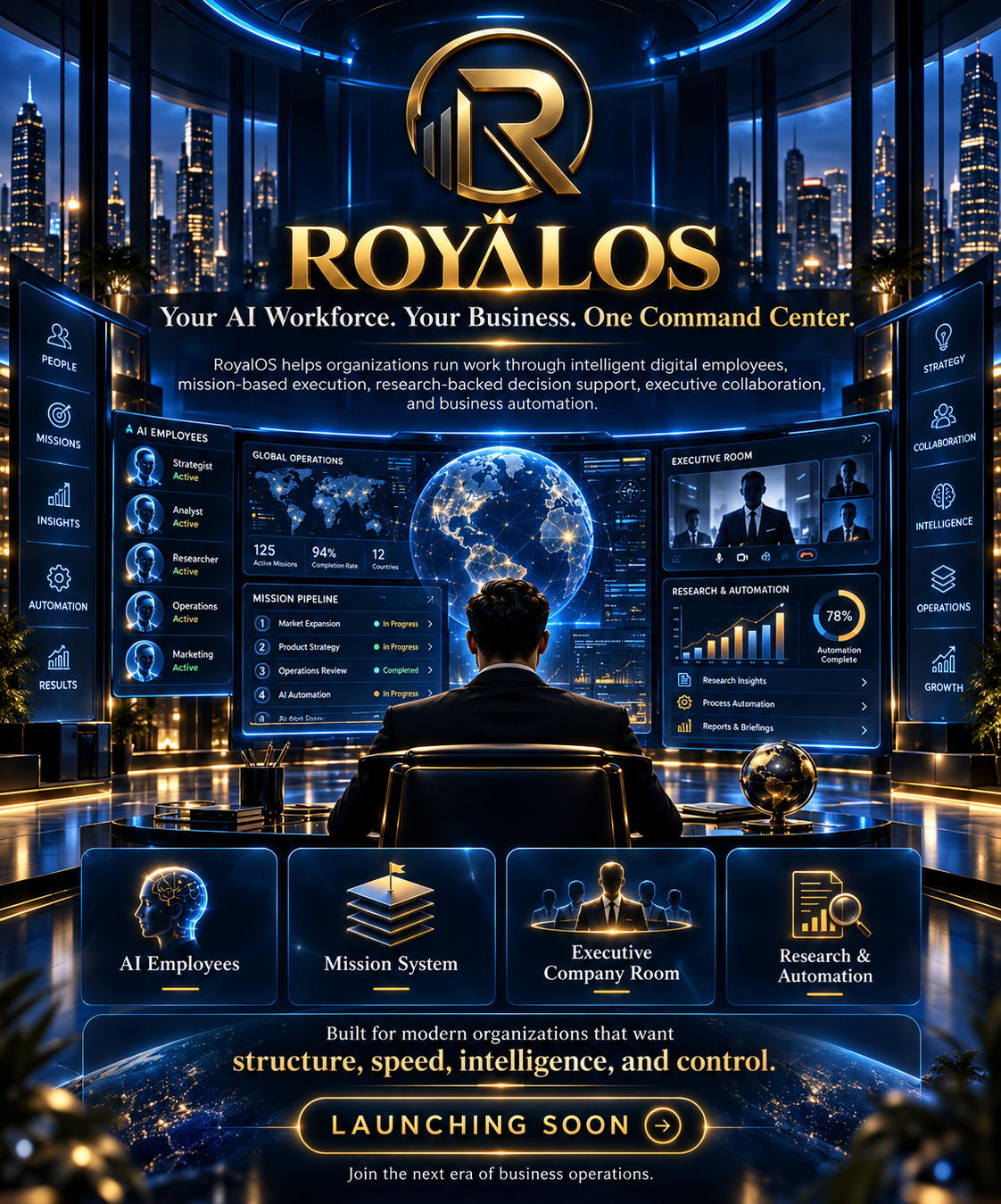
One way to organize a digital workforce is through a central business operating environment.
Rather than opening many disconnected applications, the owner can see employees, active work, missions and important organizational information from a central interface.
Specialized workspaces can be more useful than one giant AI chat
Different responsibilities often require different information.
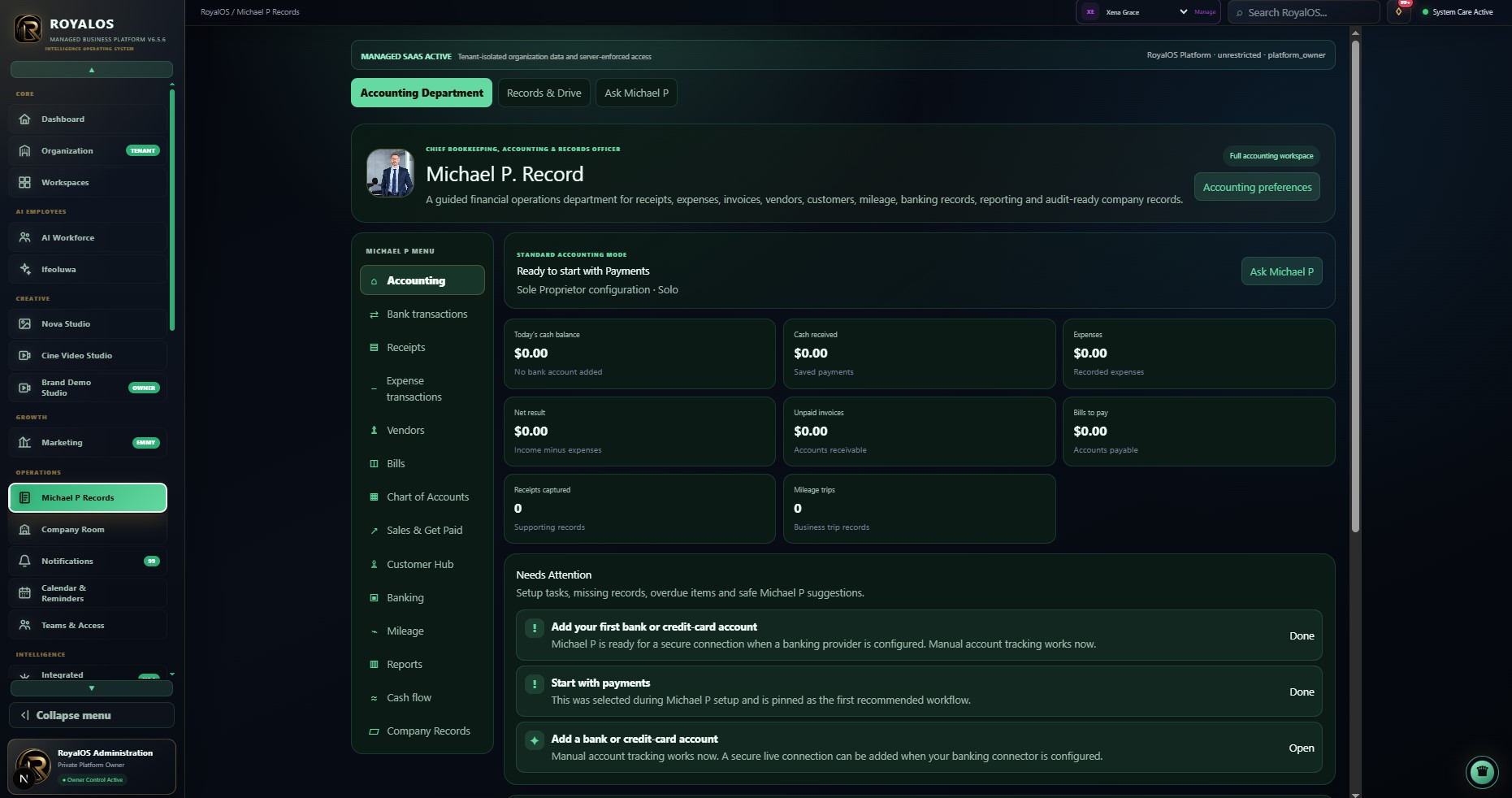
Accounting information should not necessarily be mixed with marketing conversations. Security work may require different controls than creative work.
RoyalOS, for example, is being built around specialized employee experiences.
Michael P is the accounting and bookkeeping employee within the RoyalOS workforce.
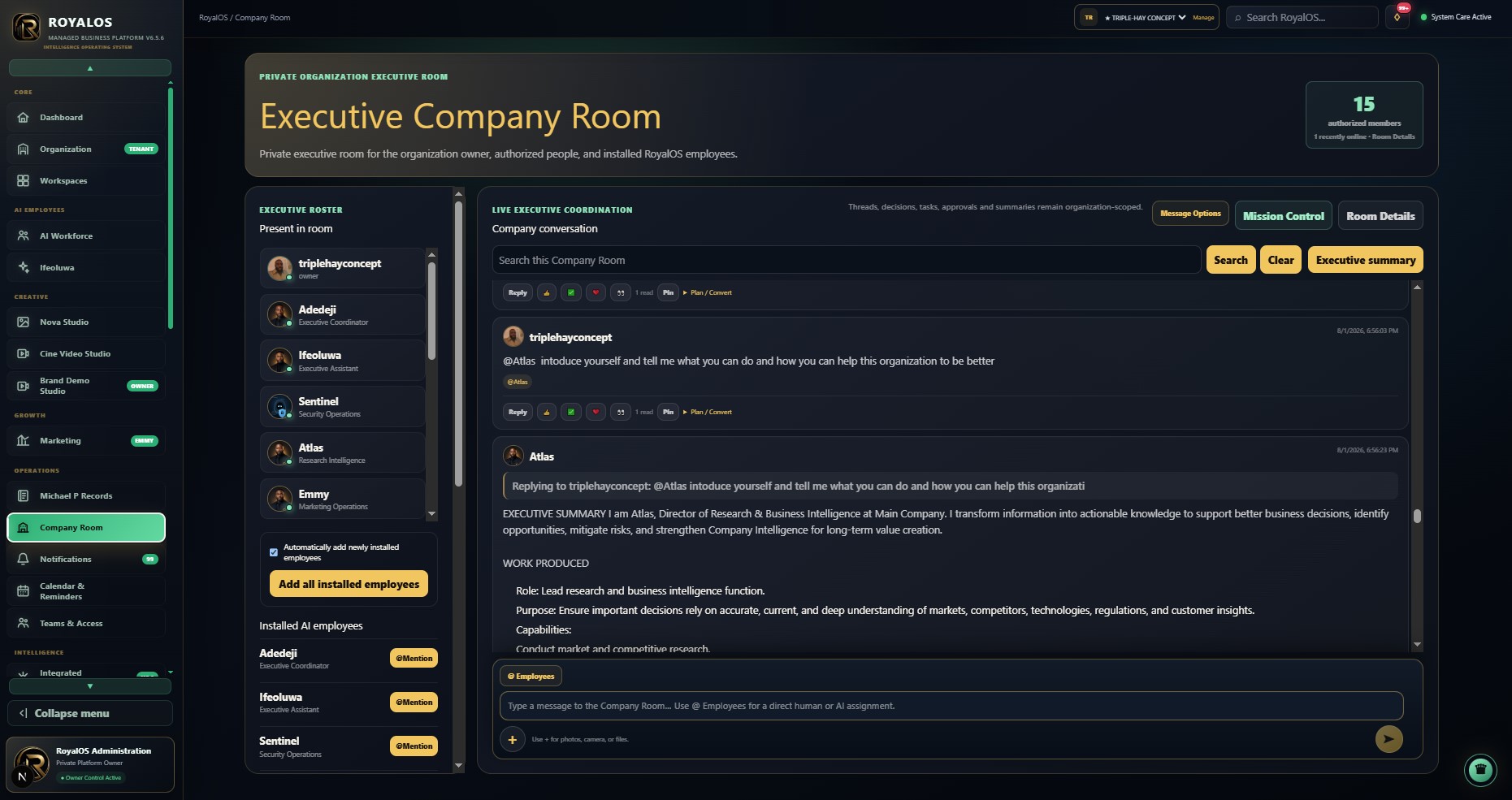
AI employees also need to work together
Real companies rarely make every decision inside a single department.
Marketing affects revenue. Technology can affect security. Financial limitations can affect operations. Customer experience can influence product strategy.
That creates another challenge for AI workforce software: specialized employees should not become isolated artificial-intelligence silos.
There needs to be a way to bring relevant employee perspectives together when an important business decision crosses several functions.
What is mission-based AI work?
A mission turns a business goal into something more structured than a prompt.
Instead of asking an AI one question and walking away, the organization can define an outcome, assign responsibility, conduct relevant research, review evidence, track progress and decide what should happen next.
That concept may become especially useful as businesses begin giving AI systems more complicated responsibilities.
Where does the human owner fit?
An AI workforce does not automatically mean humans disappear from the organization.
In many business situations, the more responsible design is likely to involve human oversight.
Owners and managers may still need to review recommendations, inspect research, approve consequential decisions and decide when automated work should continue.
This is particularly important when decisions involve money, customers, security, legal obligations or other significant business risks.
Could an AI workforce help a small business?
Small businesses may be one of the most interesting use cases.
A large company can hire separate departments for research, marketing, analytics, technology, administration and operations.
A founder or very small team often has to perform many of those roles personally.
That means the value of an AI workforce is not necessarily replacing a large number of employees. It can also be about helping a small organization develop more operational capacity.
RoyalOS is being built around this idea
At Triple-Hay Concept, we are building RoyalOS around the concept of a structured AI workforce for real organizations.
RoyalOS combines AI employees, organization personalization, missions, research-aware workflows, business intelligence, specialized employee areas and an Executive Company Room.
The platform is currently in pre-launch development and testing, and its capabilities will continue to evolve before public release.
You can explore the full RoyalOS platform overview on ChoiceRoyals.
Meet RoyalOS: Your AI Workforce. Your Business. One Command Center.
Explore the RoyalOS vision or join the early-access list as development continues toward public launch.
Frequently asked questions
What is an AI workforce?
An AI workforce is a group of specialized digital employees or intelligent systems organized around different roles, responsibilities and workflows inside an organization.
What is an AI employee?
An AI employee is a digital role configured to assist with a particular business responsibility such as research, marketing, operations, technology, accounting or executive coordination.
Is an AI workforce the same as an AI chatbot?
Not necessarily. A chatbot is primarily a conversational interface. An AI workforce model can include specialized roles, organizational context, missions, workflows, research and coordination across different responsibilities.
Can small businesses use AI employees?
AI employees may be useful to small businesses because founders and small teams often have to perform responsibilities that larger companies divide across multiple departments.
What is RoyalOS?
RoyalOS is a pre-launch AI workforce and business command environment being developed by Triple-Hay Concept. It is designed around specialized AI employees, missions, research, organizational context and executive collaboration.